
Build your solution
Lorem ipsum dolor sit amet, consectetur adipiscing elit, sed do eiusmod tempor.
Build your solution
Lorem ipsum dolor sit amet, consectetur adipiscing elit, sed do eiusmod tempor.
Fire alarm monitoring helps partners protect the people, property and reputation that underpin their business. Whether you are responsible for a single commercial premises or a portfolio of sites, continuous monitoring reduces fire risk, supports regulatory compliance and provides the evidence needed to demonstrate that appropriate fire safety measures are always in place. By adopting intelligent fire alarm monitoring, partners can minimise financial exposure while ensuring the business remains resilient in the event of a fire.
Partners share responsibility for protecting the long-term success of their business. Fire alarm monitoring provides the visibility and oversight needed to reduce operational risk while ensuring that fire safety remains effective across every property.
.png)
Partners have a duty to ensure that appropriate fire safety measures are maintained throughout their organisation. Following a serious fire incident, regulators, insurers and investigators may examine whether suitable precautions were implemented and maintained before the event occurred.
Fire alarm monitoring supports this responsibility by automatically recording alarm activations, faults, maintenance activities and fire safety events. This creates a secure digital audit trail that demonstrates a proactive approach to managing fire risks while providing valuable evidence should the business ever need to respond to regulatory enquiries or legal proceedings.
A significant fire can affect every aspect of a business, from property damage and operational disruption to customer confidence and long-term profitability. Even where physical damage is limited, prolonged downtime and reputational harm can have lasting commercial consequences.
Continuous fire alarm monitoring enables emergency services to be notified more quickly while helping facilities teams respond rapidly to developing incidents. Earlier intervention reduces the potential impact of fire events, helping partners protect business continuity and maintain confidence among customers, employees and stakeholders.
Managing fire safety across multiple properties presents significant administrative and operational challenges. Maintaining consistent standards becomes increasingly difficult when records are held separately or managed manually.
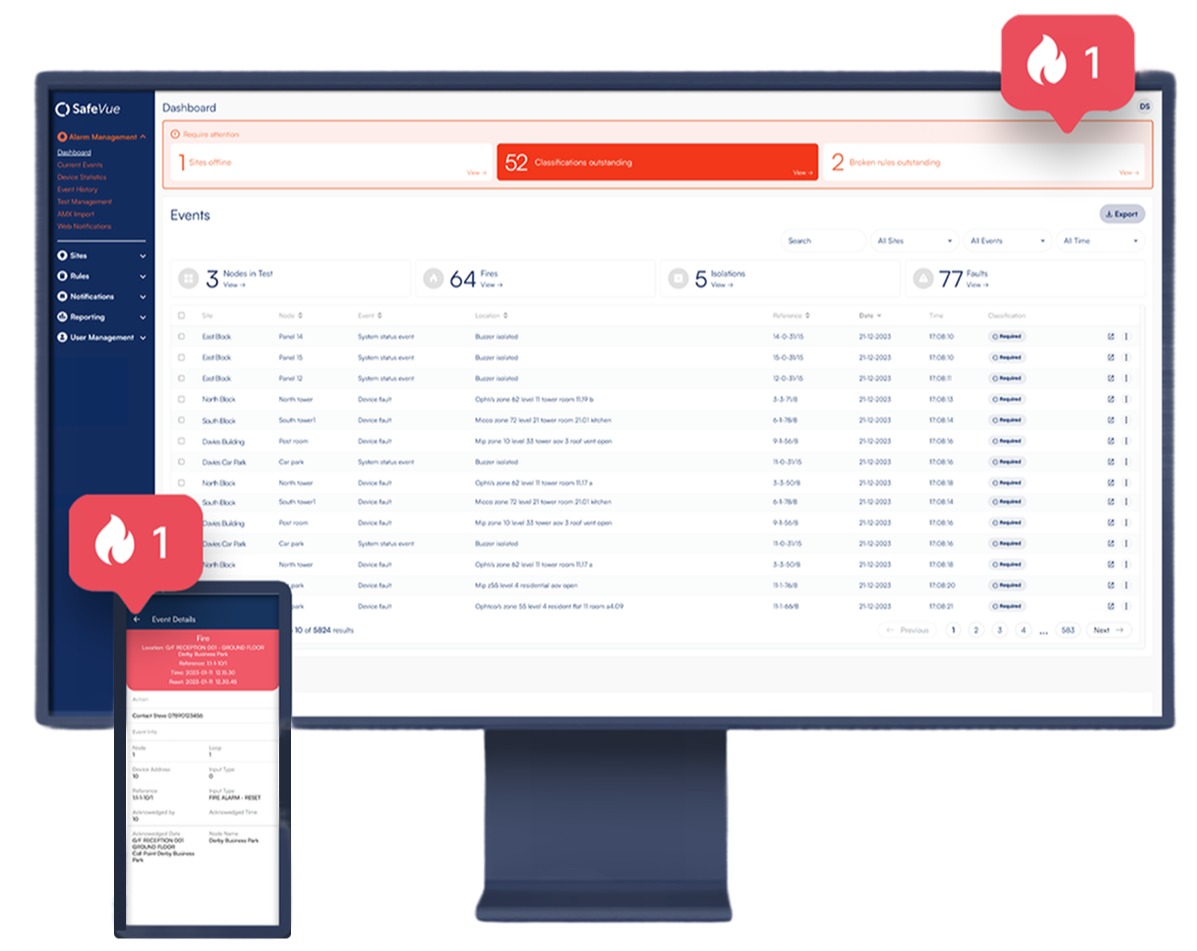
Fire alarm monitoring provides central oversight of every monitored site, allowing partners to view alarm activity, faults, maintenance records and compliance information across their entire property portfolio. This simplifies governance while ensuring that fire safety standards remain consistent throughout the business.
Modern fire alarm monitoring goes beyond simply receiving alarm signals. It provides the information needed to identify risks earlier, improve compliance and support better business decisions.
Continuous monitoring ensures that fire alarms and significant system faults are reported immediately, regardless of the time of day. This reduces the likelihood of fire incidents developing unnoticed while enabling faster emergency response when genuine alarms occur.
By maintaining continuous oversight of fire safety systems, partners can demonstrate that they have taken reasonable steps to manage fire risks proactively rather than reacting only after problems occur.
Accurate documentation is essential when demonstrating compliance or responding to insurance claims and regulatory investigations. Manual records can be incomplete, inconsistent or difficult to retrieve when required.
Fire alarm monitoring automatically creates a comprehensive digital record of alarm activations, maintenance activities, faults, testing and fire drills. This provides an easily accessible audit trail that supports internal governance while giving partners confidence that key information is always available.
Preparing compliance reports manually can consume valuable time while increasing the risk of administrative errors. Automated reporting simplifies this process by collecting fire safety data continuously and presenting it in a consistent format.
Regular compliance reports help partners monitor fire safety performance across all sites while providing evidence that maintenance activities, testing schedules and system performance are being effectively managed.
Business interruption is often one of the most expensive consequences of a fire. Fire alarm monitoring helps organisations respond more quickly while reducing unnecessary operational disruption.
False alarms interrupt business operations, disrupt employees and customers, and can result in unnecessary emergency service attendance or financial penalties. Repeated false alarms also reduce confidence in evacuation procedures and consume valuable maintenance resources.
Fire alarm monitoring records every alarm activation and system fault, making it easier to identify recurring causes and schedule targeted maintenance. Reducing false alarms helps keep buildings operational while ensuring genuine emergencies receive the appropriate response.
The sooner a fire is detected and acted upon, the greater the opportunity to contain it before significant damage occurs.
Monitored fire alarm systems transmit alarm signals immediately, allowing emergency procedures to begin without delay. Faster response times help limit property damage, reduce operational disruption and enable organisations to return to normal activities more quickly following an incident.
Effective fire safety management not only reduces operational risk but can also lower the long-term financial costs associated with property ownership and business continuity.
Insurance providers assess the level of fire risk when determining policy terms and premiums. Organisations that demonstrate a proactive approach to managing fire safety may be viewed more favourably during the underwriting process.
Continuous fire alarm monitoring helps demonstrate that fire risks are actively managed across the business, supporting discussions with insurers and potentially contributing to improved insurance terms where appropriate.
Many commercial insurance policies include conditions relating to the maintenance and operation of fire safety systems. Failure to demonstrate compliance with these requirements could affect the outcome of an insurance claim following a fire.
Automated compliance reporting provides accurate records of system performance, maintenance and testing, helping organisations demonstrate that fire safety obligations have been maintained throughout the policy period and supporting the validity of insurance cover.