Explore Drax Technology
See how our solutions can work across your portfolio
Explore Drax Technology
See how our solutions can work across your portfolio
Fire alarms, fire doors and water safety across the whole venue- live, on event day and on the sixty nights nobody's in the building. Know what's actually active tonight, not what the last handover said.
On event day, an alarm isn't a job- it's a decision: With a full bowl, someone has minutes to work out whether that detector means a fryer, a smoke machine or a fire. Isolations go on for hot works, pyros and catering, and the ones that don't come off afterwards are invisible until the next event.
Doors take a beating from the people using them: Hundreds of doors across concourses, back of house and hospitality, propped by crew, wedged by caterers and knocked about by crowds. A quarterly walk round finds it weeks after the night it happened.
The venue is dark most of the year: Away dressing rooms, hospitality kitchens and concourse outlets used twenty nights a season. Water sits in the pipes in between, and a manual flushing regime tells you what was true on the day someone remembered.
Every event brings a different set of people: Promoters, contract caterers, stewarding providers, riggers and contractors, all changing event to event. When the safety certificate, the SAG or an insurer asks for evidence, somebody spends a fortnight assembling an answer.
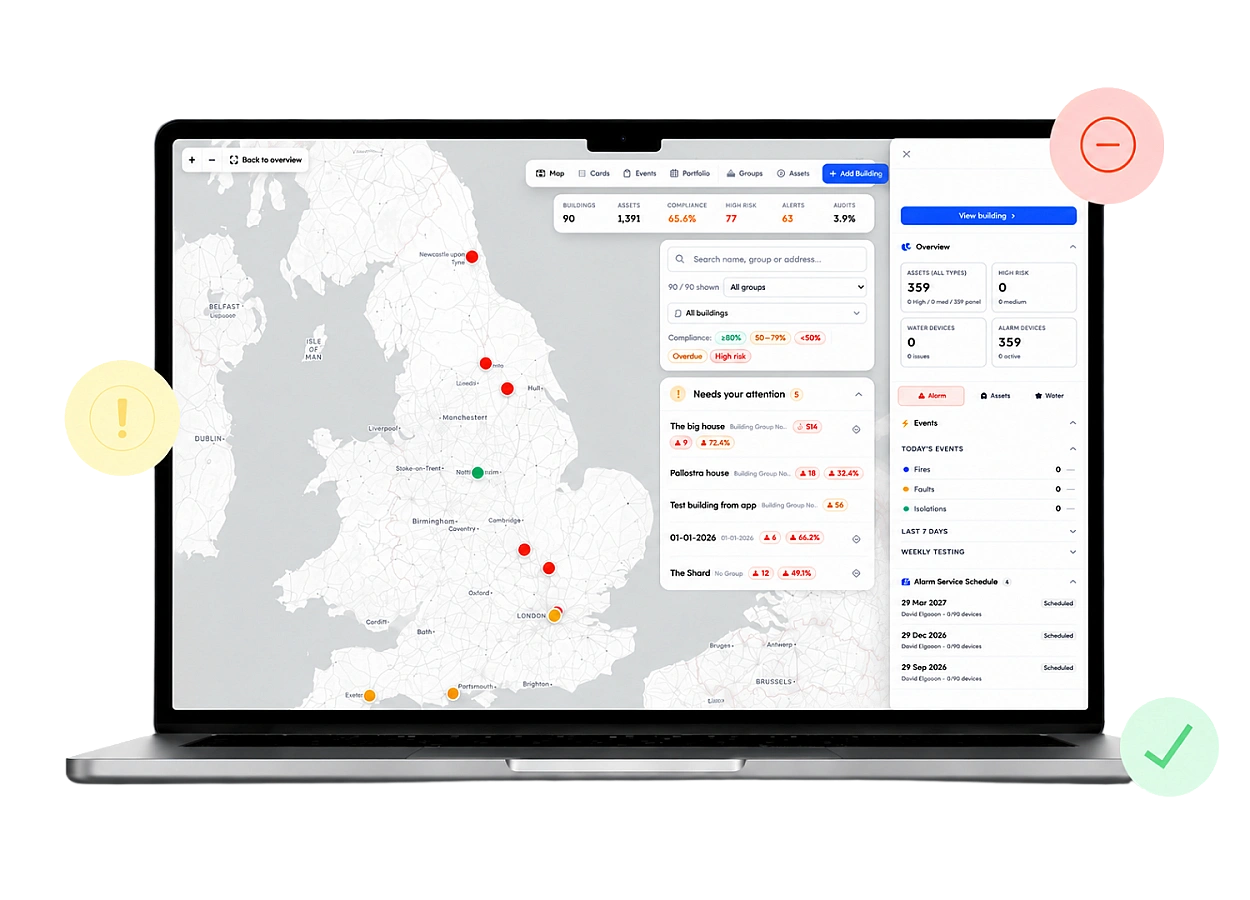
Live alarm data, faults, isolations and testing across the whole venue. See exactly what's isolated and how long it's been that way, so nothing walks into the next event switched off. "The risk isn't the alarm you responded to. It's the one you didn't see."
Inspect on a phone, evidence attached. A wedged or damaged door becomes a tracked job with an owner and a date, found the morning after the event, not the quarter after. "An inspection is not an outcome."
Temperature and flow monitored constantly, including the dressing rooms and hospitality outlets nobody's touched since the last fixture. Control shown by data, not by a signature on a flushing sheet. "Monthly checks tell you what was true on the day someone visited."
Live alarm data, faults, isolations and testing across the whole venue. See exactly what's isolated and how long it's been that way, so nothing walks into the next event switched off. "The risk isn't the alarm you responded to. It's the one you didn't see."
Inspect on a phone, evidence attached. A wedged or damaged door becomes a tracked job with an owner and a date, found the morning after the event, not the quarter after. "An inspection is not an outcome."
Temperature and flow monitored constantly, including the dressing rooms and hospitality outlets nobody's touched since the last fixture. Control shown by data, not by a signature on a flushing sheet. "Monthly checks tell you what was true on the day someone visited."
Device location and cause, not just "an alarm". Every live isolation on one screen before doors open.
The right person moving with the information they need, assigned by name, attendance tracked- staff or contractor, event day or not.
Every decision time stamped as it happened. Every check, isolation and fix with a record, ready for the certifying authority.























Safety officers and ground safety officers, heads of operations and facilities, technical services managers, and the certificate holder who carries the risk on the night.
When safety and compliance information is fragmented, it becomes harder to maintain control across a large venue at capacity. This can lead to delayed responses, inconsistent reporting, reduced accountability and increased pressure during audits or regulatory checks- and on event day, the margin for error narrows considerably.
Real-time monitoring, data-driven insights, and seamless integration - helping organisations reduce false alarms, streamline maintenance and enhance fire safety strategies

.png)




.png)