Explore Drax Technology
See how our solutions can work across your portfolio
Explore Drax Technology
See how our solutions can work across your portfolio
Fire alarm monitoring provides engineers with the real-time data and system visibility needed to maintain reliable fire protection across commercial buildings. Beyond transmitting alarm signals to a monitoring centre, modern fire alarm monitoring delivers valuable insight into system performance, fault conditions and fire events, enabling engineers to diagnose issues more quickly, optimise maintenance strategies and improve overall fire safety.
Engineers play a critical role in ensuring that fire alarm systems remain reliable, compliant and fully operational throughout their service life. Continuous monitoring supports these responsibilities by providing instant visibility of fire events, system faults and communication issues across one or multiple sites.
.png)
Every alarm activation, system fault, fire drill and maintenance event generates valuable operational data. Without effective monitoring, this information can become fragmented across different systems or be lost altogether through manual record keeping.
Fire alarm monitoring automatically records every significant event, allowing engineers to analyse alarm history, identify recurring issues and understand how systems perform over time. These insights support informed engineering decisions while helping improve long-term system reliability.
Modern commercial buildings contain valuable infrastructure, plant equipment and business-critical assets that require continuous protection. Fire alarm monitoring provides immediate notification of alarm activations and system faults, reducing the time between fire detection and emergency response.
Early notification helps limit fire damage while ensuring that faults affecting the fire alarm system are identified before they compromise building protection.
For engineers responsible for maintaining life safety systems, continuous monitoring provides confidence that fire protection remains operational around the clock.
Maintaining compliance requires more than simply installing compliant equipment. Fire alarm systems must continue operating correctly throughout their operational life, with faults identified and rectified promptly.
Fire alarm monitoring supports compliance by providing continuous oversight of system status while automatically recording alarms, faults, maintenance activities and testing. This creates a comprehensive digital audit trail that supports inspections, servicing and regulatory reporting.
Modern fire alarm monitoring provides engineers with far more than alarm notifications. It delivers actionable information that supports preventative maintenance, system optimisation and better engineering decisions.
Comprehensive event logging records every significant system activity, including fire alarms, faults, disablements, resets, maintenance activities and communication failures.
Having access to a complete event history enables engineers to investigate incidents more efficiently, identify intermittent faults and verify that maintenance activities have resolved recurring issues. Digital event logs also eliminate the need to rely on incomplete manual records.
False alarms remain one of the biggest operational challenges for commercial fire alarm systems. Repeated unwanted alarms reduce confidence in evacuation procedures, create unnecessary disruption and increase maintenance costs.
Fire alarm monitoring enables engineers to analyse alarm trends across individual devices, zones and buildings, making it easier to identify persistent problem areas. This allows maintenance activities to focus on addressing root causes rather than repeatedly responding to individual alarm events.
The result is improved system reliability, reduced disruption and fewer unnecessary emergency callouts.
Many serious fire incidents are preceded by developing faults or unusual alarm activity that may otherwise go unnoticed.
Continuous monitoring provides engineers with early warning of communication failures, detector faults, power supply issues and abnormal system behaviour, allowing remedial work to be scheduled before these problems affect the effectiveness of the fire alarm system.
This proactive approach helps maintain continuous fire protection while reducing the likelihood of unexpected system failures.
Fire alarm monitoring becomes even more valuable when integrated with other building systems, enabling coordinated responses that protect both people and critical infrastructure.
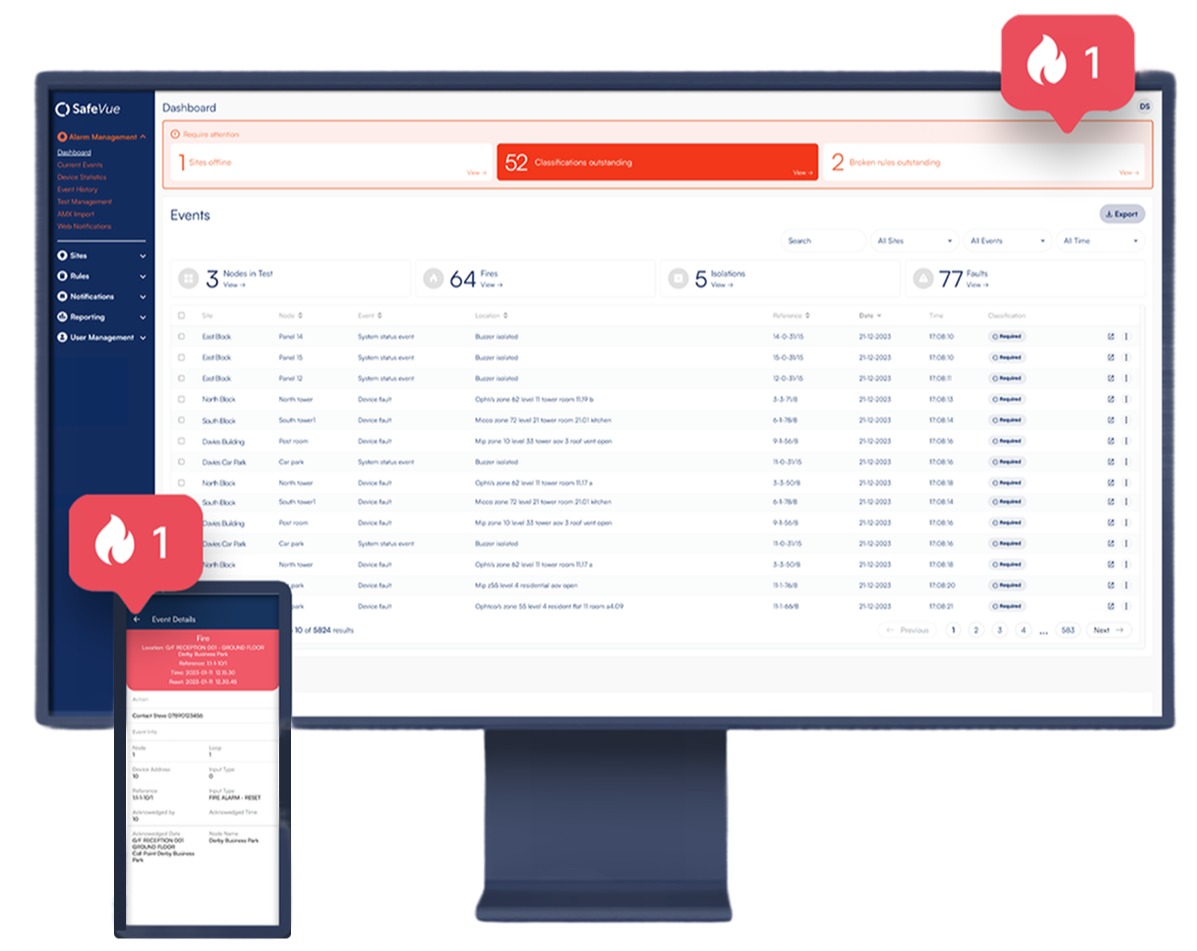
Addressable fire alarm systems can identify the precise location of a fire, allowing suppression measures to be targeted to the affected area rather than the entire building.
When integrated with monitored fire alarm systems, this information enables faster emergency response while supporting more effective operation of suppression systems, smoke control equipment and compartmentation measures.
Limiting the spread of fire helps reduce property damage, minimise operational disruption and protect critical building infrastructure.
Modern commercial buildings increasingly rely on interconnected safety systems that work together during an emergency. Fire alarm monitoring can be integrated with Building Management Systems (BMS), smoke control systems, access control, HVAC, emergency lighting and security systems to create a coordinated building response.
This integrated approach enables engineers to monitor multiple life safety systems through a central platform while improving situational awareness during emergency incidents and simplifying ongoing system management.
Reactive maintenance often results in unnecessary disruption and increased costs. Fire alarm monitoring enables engineers to adopt a preventative approach that improves both system performance and regulatory compliance.
Continuous monitoring identifies faults as they occur rather than waiting until scheduled maintenance visits. Engineers can prioritise corrective actions based on the severity of the issue, helping prevent minor faults from developing into significant system failures.
By addressing issues earlier, organisations can reduce downtime, improve system availability and extend the operational life of fire safety assets.
Fire alarm systems are expected to provide continuous protection, not just during normal working hours. Monitoring ensures that alarm systems remain under constant supervision, with faults and alarm activations reported immediately regardless of the time of day.
Combined with automated event recording and comprehensive audit trails, continuous monitoring helps engineers demonstrate that fire protection systems have remained operational while supporting ongoing compliance with maintenance and testing requirements.