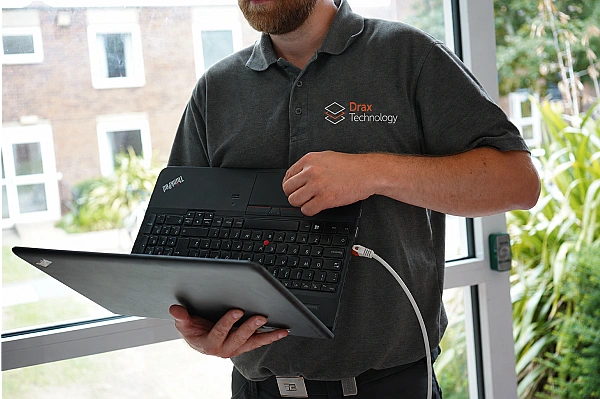
Explore Drax Technology
See how our solutions can work across your portfolio
Explore Drax Technology
See how our solutions can work across your portfolio

Delivering resilient, real-time fire alarm monitoring across the University of Exeter’s diverse estate
Legacy system limitations occasionally caused operational issues, especially during power interruptions or network disruptions. It became clear that a flexible, resilient architecture with real-time visibility and seamless IT integration was essential.
“This was one of the most technically complex projects we’ve undertaken. The University of Exeter’s estate spans hundreds of buildings, many with heritage or Conservation restrictions, and has a wide variety of legacy fire panels. The project required meticulous planning and custom engineering solutions. We’re proud to see the outcome deliver a robust, future-proof system for the University.”
—
Glenn Creighton, Head of Tech Operations, Drax Technology
Modernising the system required work across a live campus operating seven days a week. Installations had to be planned around teaching timetables, accommodation occupancy, laboratory operations, and city-centre constraints.
The migration also needed to maintain continuity while transitioning from the legacy analogue network to new digital pathways. The solution had to integrate with 245 fire panels from multiple manufacturers while remaining operational during IT failures, prolonged power outages, weekends, bank holidays, and shutdown periods.
Additional challenges included integrating with the university’s wider IT ecosystem, working within listed and Conservation-area buildings, overcoming poor 4G coverage in basement locations, and monitoring systems beyond fire alarms including refuge points, panic alarms, accessible toilets, bedroom alarms, and flood alarms.

“The challenge was to modernise an ageing analogue network while building a platform capable of scaling with the University’s future needs and able to keep pace with the complexity of our estate. Real-time monitoring, device-level detail, and seamless integration with our IT systems were essential so our teams could respond immediately, manage issues efficiently, and reduce unnecessary travel across campus.”
— TJ Adams, Systems Engineer, University of Exeter
Drax Technology deployed a phased migration strategy centred on AMX1 multi-panel monitoring, SafeVue, dual-SIM dual-modem 4G routers, and industrial-grade UPS resilience.
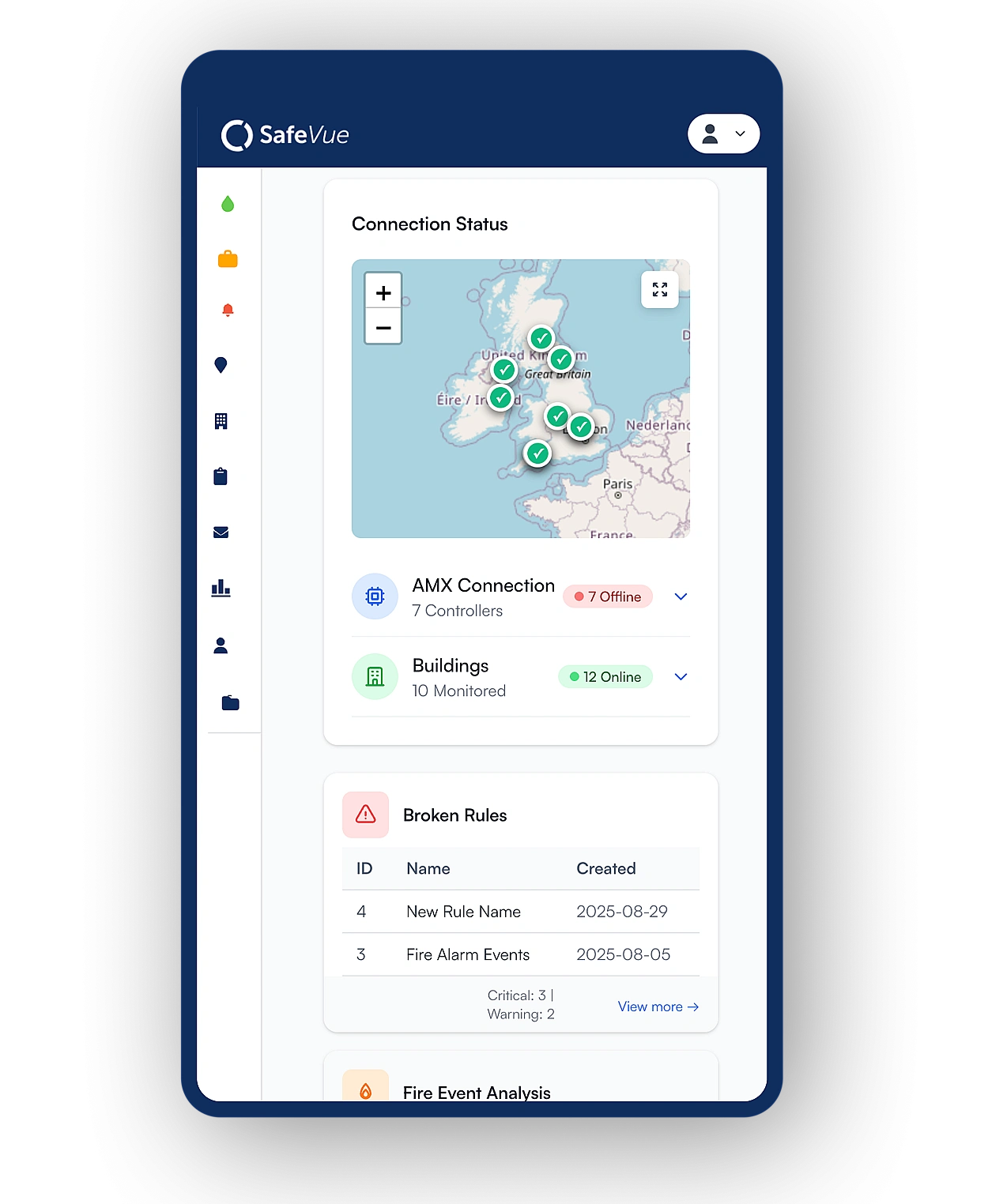
AMX1 software was installed on PCs across five strategic locations, with each connected through both IT network and 4G pathways to ensure uninterrupted communication during outages. SafeVue provided real-time, device-level fire and fault alerts, historic event logs, detailed room and location data, and full remote panel visibility equivalent to standing in front of the physical panel.
The implementation also introduced resilient communication hardware with automatic failover functionality and UPS systems capable of delivering up to 80 hours of backup power.
Provided automatic communication failover during IT network outages.
Connected 245 fire panels from multiple manufacturers across the estate
Enabled connected monitoring across multiple fire panels and strategic locations.
Delivered real-time alerts, historic event logging, and detailed device-level visibility.
Provided automatic communication failover during IT network outages.
Connected 245 fire panels from multiple manufacturers across the estate
Enabled connected monitoring across multiple fire panels and strategic locations.
Delivered real-time alerts, historic event logging, and detailed device-level visibility.
“The difference is tangible for our teams. They can now see exactly what’s happening in any building, respond immediately to issues, and manage the estate safely and confidently without the guesswork of our old analogue system. Combined with the robust 4G and UPS backup systems, we know the network will keep running even during power outages or IT failures. It’s transformed how we operate.”
Real-time detail allows the fire safety team to respond immediately with precise alarm and location information.
.png)
Remote visibility reduced unnecessary travel across campus and improved response times.
.png)
Dual-path 4G redundancy and extensive UPS backup ensure continued operation during power outages and IT failures.
.png)
The platform established a scalable foundation capable of supporting future estate expansion.
.png)
Real-time monitoring and historic reporting improved operational awareness across the university.
Real-time detail allows the fire safety team to respond immediately with precise alarm and location information.
Remote visibility reduced unnecessary travel across campus and improved response times.
Dual-path 4G redundancy and extensive UPS backup ensure continued operation during power outages and IT failures.
The platform established a scalable foundation capable of supporting future estate expansion.
Real-time monitoring and historic reporting improved operational awareness across the university.
“It has been a pleasure and a highlight of my career commissioning a complex system of this scale. I have gained huge satisfaction working with all key partners including suppliers, sub-contractors, IT Engineers and most of all the end client. I am hopeful this system will evolve further to include additional buildings around Exeter city and will hopefully provide as much longevity as its predecessor.”
— Glenn Creighton, Head of Tech Operations, Drax Technology